

Disclaimer: This newsletter is for educational and informational purposes only and does not constitute medical, investment, or financial advice, nor does it establish a provider-patient relationship. Content may include forward-looking statements and discussions of investigational therapeutic candidates that are not FDA/EMA approved; their safety and efficacy remain unestablished and clinical outcomes are unpredictable. While we strive for accuracy, all information is provided as is without guarantees. As of the date of publication, the author holds no direct equity positions in the specific companies mentioned in this issue nor receives third-party compensation for this coverage. Please find a complete version of our disclaimers linked here.

If you are a paid subscriber, go to ophthalmology competitive landscape here ⬇️
If you are a free reader or subscriber, enjoy the whole article free of charge and consider upgrading for competitive landscapes of disease areas & therapeutics modalities; view samples here.
Introduction
On November 16, 2026, Johnson & Johnson announced a definitive agreement to acquire Ollin Biosciences, Inc. for for $2.2 billion upfront, with the potential for regulatory and commercial milestone payments up to approximately $1.125 billion, for a total deal value of up to $3.325 billion (J&J press release, Ollin press release). This acquisition centers on two investigational, China-licensed ophthalmology assets:
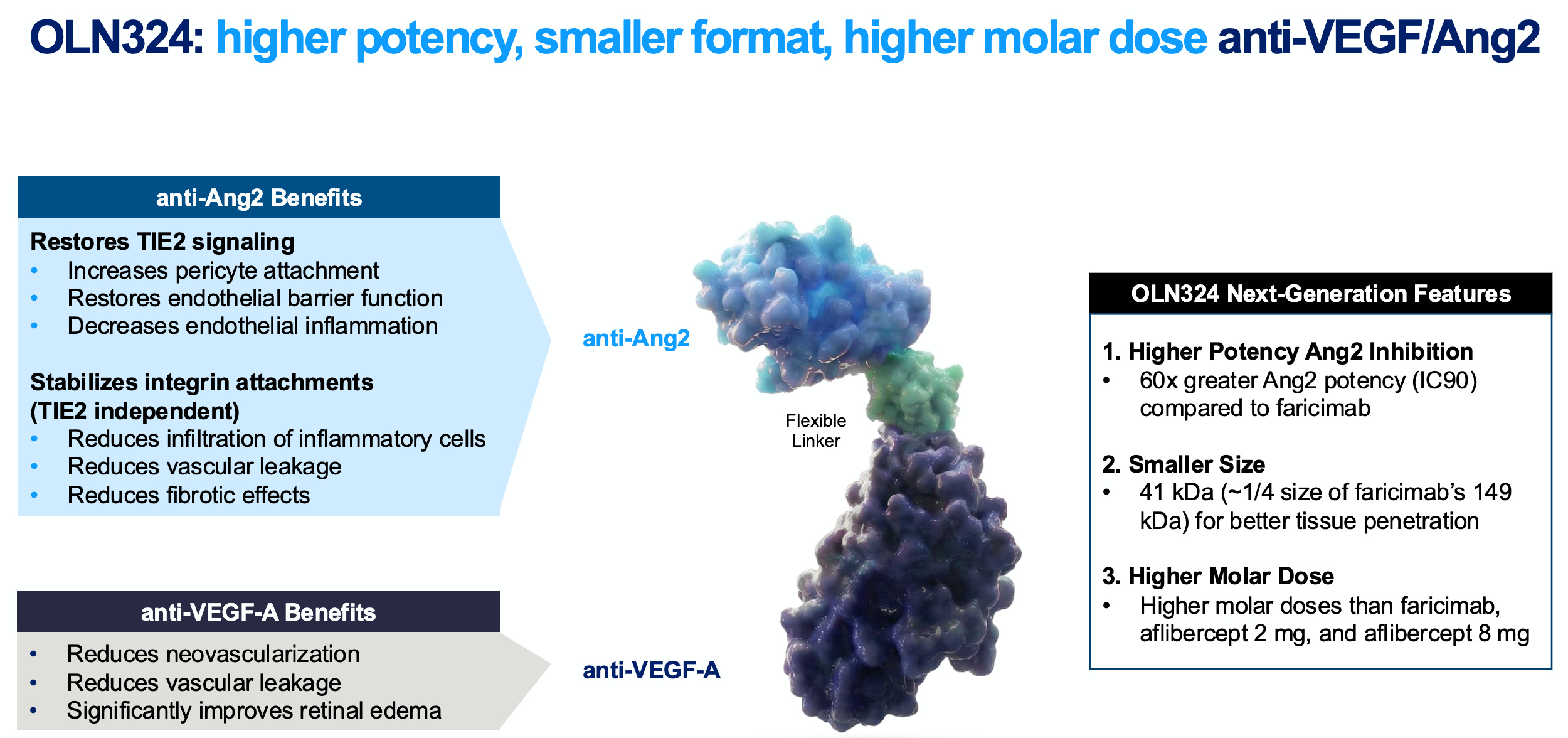
OLN324 (Phase 3-ready VEGF x Ang2 mAb): Discovered by China-based Innovent Biologics and licensed to Ollin, OLN324 is an intravitreal bispecific antibody engineered to improve upon Roche’s market leader, Vabysmo (faricimab). It features substantially higher Ang2 binding potency, a smaller protein format, and a higher molar dose relative to both faricimab and aflibercept (including Eylea HD), designed to drive faster retinal drying and longer durability between injections.
OLN102 (Preclinical TSHR x IGF-1R mAb): Discovered by China-based VelaVigo and licensed to Ollin, OLN102 is a first-in-class bispecific antibody targeting both the thyroid-stimulating hormone receptor (TSHR) and the insulin-like growth factor 1 receptor (IGF-1R). In Thyroid Eye Disease (TED), autoantibodies activate TSHR on orbital fibroblasts, triggering physical and functional receptor cross-talk with overexpressed IGF-1R that drives orbital inflammation, tissue remodeling, and proptosis. Existing approved therapies (such as teprotumumab / Tepezza) inhibit IGF-1R alone across systemic tissues, leading to on-target toxicities like hearing impairment and hyperglycemia. By co-engaging TSHR alongside IGF-1R, OLN102 is engineered for selective tissue targeting to orbital and thyroid tissues, aiming for a wider therapeutic index and improved safety compared to Tepezza. It is formulated for subcutaneous administration rather than intravenous infusion.
In this article, we take a closer look at VEGF x Ang2 bispecifics in optho (Vabysmo & EyeBio), address the elephant in the room (China “Me Better” Arbitrage), and explore how Ollin pulled off a +$3 billion exit within 3 short years of its founding.
VC x China Bispecifics
First, the elephant in the room. Ollin’s corporate history isn’t a surprise overnight success, but rather a highly tactical strategy leveraged by biotech venture capital companies that I call the China “Me Better” Arbitrage. I discussed how it worked in my China Biotech article:
In the pharmaceutical industry, “me-too” and “me-better” are terms used to describe drugs that are structurally similar to an already approved, pioneering “first-in-class” drug. They target the exact same biological mechanism, but their development strategies and clinical impacts differ significantly. A “me-too” drug is a follow-on therapeutic that uses the same mechanism of action as the innovator drug and offers comparable clinical efficacy and safety profiles, with no major advantages. A “me-better” drug targets the same established mechanism but features intentional modifications to secure a clear, quantifiable clinical advantage over the pioneer in terms of safety, efficacy, or convenience. Separately, arbitrage is the practice of leveraging a price difference for the exact same asset, commodity, or service across two or more markets.
Put them together and you get a shiny new business model: the China “Me-Better” Arbitrage model, where Western VCs let the streamlined NMPA framework [in China] de-risk the molecule in human patients quickly and then package that clean data into a [US-based new company (NewCo)] ready for a potential Big Pharma acquisition. China’s hyper-efficient regulatory engine is the exact mechanism that feeds the “Me-Better” Arbitrage model. The model has evolved from an occasional creative structuring trick into a highly institutionalized, rapid-exit [strategy] for cross-border drug development.
To fully grasp this phenomenon, it helps to look at the exact anatomy of an arbitrage and how it acts as a geopolitical firewall for international innovation. Unlike traditional biotech company creation, which focuses on building long-term, multi-decade platform technologies with massive brick-and-mortar footprints, a NewCo is structurally designed to be a temporary vehicle to house a specific drug. The model follows four general phases:
In-Licensing a “Me-Better”: A Western venture capital (VC) firm identifies a highly promising asset developed by a Chinese biotech. Usually, this asset has already generated early, encouraging data in local Chinese clinical trials. The Western VC licenses the “Ex-China” rights (typically encompassing the U.S., Europe, and Japan), while the Chinese firm retains domestic commercial rights.
Establishing a NewCo Shell: The VC firm spins up a lean, clean startup (the “NewCo”) often domiciled in Delaware or Europe. The company is funded with just enough seed capital to execute an immediate operational objective, such as filing a U.S. IND (Investigational New Drug) application or starting a targeted Phase 1/2 trial.
Hiring a “SWAT Team”: Instead of hiring a massive workforce, the NewCo operates with a skeleton crew of highly experienced “swat team” executives, often seasoned drug developers or entrepreneurs who have successfully sold companies before. The NewCo completely outsources its clinical trials, regulatory filings, and manufacturing scale-up to third-party Contract Research Organizations (CROs) and CDMOs. Most dollars raised go directly into driving the specific clinical asset forward.
Arbitrage Exit: Within 12 to 24 months of formation, sometimes even before the NewCo has run a single trial in the U.S., the asset’s data matures in China. If the data looks spectacular, a Big Pharma company can step in and buy the entire NewCo shell outright. If an acquisition occurs, the VCs secures a rapid and capital-efficient liquidity event, and Big Pharma takes ownership of the drug to plug into their global Phase 3 machine.
There are several reasons why this model works exceptionally well, when executed with the right expertise:
Speed to Data: Since Chinese biotechs operate at an incredibly high velocity and have access to massive patient pools, they can advance an asset from discovery to proof-of-concept in humans far faster and cheaper than a U.S. counterpart. The Western NewCo essentially buys time, skipping years of early-stage discovery risk.
Extreme Capital Efficiency: Traditional platform biotechs burn hundreds of millions of dollars maintaining wet labs, internal manufacturing, and massive corporate overhead. A NewCo typically has no brick-and-mortar labs. R&D is outsourced entirely to contract research organizations (CROs). Most dollars raised are deployed directly into advancing one or two clinical assets, maximizing the return on data generated.
Geopolitical Firewall: As U.S.-China geopolitical tensions escalated, culminating in legislative pushes like the BIOSECURE Act, Big Pharma became incredibly wary of buying Chinese companies outright or entering messy, direct cross-border partnerships that could draw scrutiny from Washington. By transferring the Intellectual Property (IP) to a clean Delaware or European corporate entity, staffed by Western executives and backed by Western VCs, the asset is effectively Westernized. This makes it politically palatable for an American or European multinational to acquire.
Now, before we take a look at how Ollin arbed their way into J&J’s arms, let’s explore the intrigue around VEGF x Ang2 bispecifics in ophthalmology.
Shoulders of Giants
Vabysmo (faricimab), developed by Roche and its subsidiary Genentech, is the first and only bispecific antibody approved for intraocular use, to date. Built to overcome the dosing burden and incomplete fluid resolution of first-generation anti-VEGF monotherapies, Vabysmo simultaneously neutralizes vascular endothelial growth factor-A (VEGF-A) and angiopoietin-2 (Ang-2), growing into a mega-blockbuster program and the preferred first-line therapy across major retinal vascular diseases. Vabysmo is the second best selling ophthalmology drug behind Regeneron’s Eylea franchise at an annualized revenue run rate about $9.6 billion Eylea/Eylea HD franchise versus $5.5 billion for Vabysmo, as of 3Q 2026.
Vabysmo’s story is one of many examples of Genentech’s R&D brilliance. In the early 2010s, anti-VEGF drugs (Lucentis/ranibizumab, Eylea/aflibercept) had already transformed ophthalmology, but many patients still experienced persistent retinal fluid or vision decline in real-world practice due to the burden of monthly or bimonthly eye injections. To solve this problem, Roche/Genentech scientists focused on the Angiopoietin-Tie2 pathway: normally, Ang-1 activates the endothelial Tie2 receptor to keep retinal blood vessels tight and stable, whereas Ang-2 (heavily upregulated in diabetic and neovascular eyes) blocks Tie2, destabilizing vessels, driving inflammation, and sensitizing blood vessels to VEGF. Using Roche’s proprietary CrossMAb bispecific IgG1 platform (combining “knobs-into-holes” heavy-chain heterodimerization with CH1–CL domain crossover to ensure proper light-chain assembly), engineers paired two distinct antigen-binding arms into one ~150 kDa molecule:
An optimized anti-VEGF-A Fab derived from Lucentis
A highly selective anti-Ang-2 Fab (LC10) engineered to neutralize Ang-2 without interfering with vessel-stabilizing Ang-1
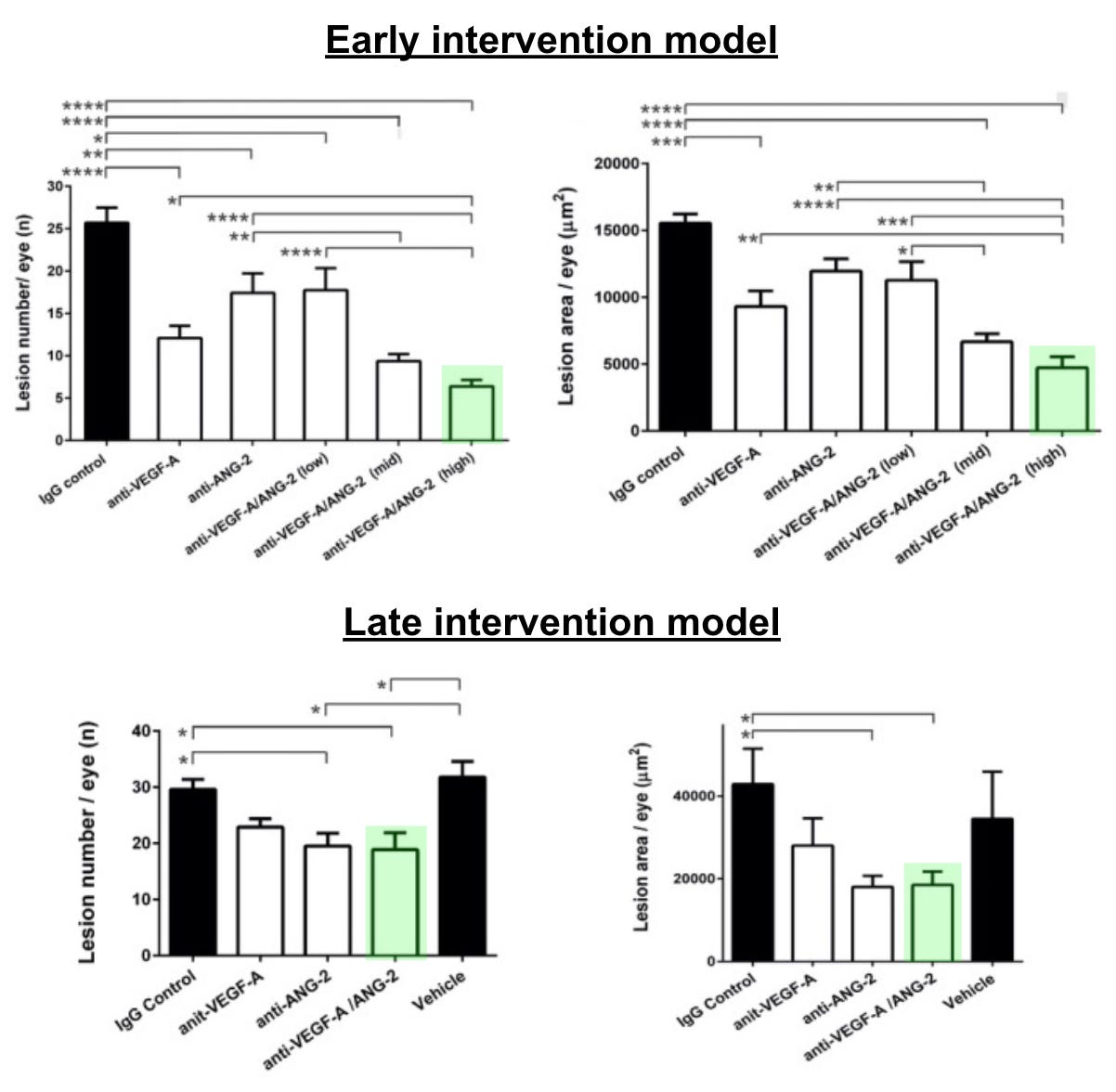
Unlike Roche’s systemic oncology anti-VEGF/Ang-2 CrossMAb (vanucizumab), faricimab’s IgG1 Fc region was specifically mutated for the eye. P329G LALA mutations abolished Fcγ receptor binding to eliminate immune-effector inflammation inside the eye. Triple A mutations abolished binding to the neonatal Fc receptor (FcRn), ensuring that any antibody leaking out of the eye into the bloodstream would be rapidly cleared rather than recycled, minimizing systemic anti-VEGF exposure. Published in EMBO Molecular Medicine in 2016, faricimab (then called RG7716) demonstrated superior reductions in vascular lesion formation, leakage, retinal edema, and neuronal loss compared with anti-VEGF monotherapy in mouse and non-human primate choroidal neovascularization (CNV) models (see graphs below).
Phase 1 SAD and MAD intravitreal studies in neovascular (”wet”) age-related macular degeneration (nAMD) established favorable safety and showed meaningful visual gains (+7.5 letters in the 6 mg multiple-dose cohort) and retinal drying (-117 µm central retinal thickness). Three Phase 2 clinical trials in a total of 600 patients provided further clinical validation:
Phase 2 BOULEVARD (DME, n=229): Tested 1.5 mg and 6.0 mg faricimab against 0.3 mg ranibizumab dosed monthly for 20 weeks, followed by 16 weeks of off-treatment observation. BOULEVARD met its superiority primary endpoint in treatment-naïve DME patients at Week 24: +13.9 ETDRS letters with 6.0 mg faricimab vs. +10.3 letters with ranibizumab (+3.6-letter advantage, P = 0.03), alongside higher rates of ≥2-step diabetic retinopathy severity improvement (38.6% vs. 12.2%) and longer time to retreatment.
Phase 2 AVENUE (nAMD, n=263): Tested multiple doses and regimens (Q4W and Q8W) against monthly 0.5 mg ranibizumab over 36 weeks. Although faricimab did not achieve superiority over monthly ranibizumab, Q8W dosing achieved comparable visual and anatomic gains, validating less-frequent dosing.
Phase 2 STAIRWAY (nAMD, n=76): Directly tested extended durability by giving four monthly loading doses of 6.0 mg faricimab followed by every-12-week (Q12W) or every-16-week (Q16W) dosing versus monthly ranibizumab. At Week 24 (12 weeks after the last loading dose), 65% of faricimab patients showed no disease activity; at Week 52, vision gains were +11.4 letters (Q16W) and +10.1 letters (Q12W) vs. +9.6 letters (monthly ranibizumab), achieved with roughly half as many injections (mean 6.2-6.7 vs. 12.9).
To support global registration, Genentech/Roche ran six massive, double-masked Phase 3 trials using aflibercept 2.0 mg (Eylea), then the dominant market leader, as the active comparator:
Wet AMD / Phase 3 TENAYA & LUCERNE (~1,329 patients): Evaluated 6.0 mg faricimab at individualized intervals up to every 16 weeks (Q8W, Q12W, or Q16W) versus fixed every-8-week aflibercept. Both trials met their primary non-inferiority endpoints at Year 1, with 45% of faricimab patients on Q16W and nearly 80% on ≥Q12W dosing. At Year 2 (treat-and-extend phase), >60% of Vabysmo patients reached every-4-month (Q16W) dosing and nearly 80% reached ≥Q12W dosing, requiring a median of 10 injections over two years vs. 15 for aflibercept.
Diabetic Macular Edema (DME) / Phase 3 YOSEMITE & RHINE (~1,891 patients): Evaluated fixed Q8W faricimab and a first-of-its-kind Personalized Treatment Interval (PTI) treat-and-extend arm against fixed Q8W aflibercept. Both arms achieved non-inferior BCVA gains (+10.7 to +11.8 letters vs. +10.3 to +10.9 letters for aflibercept at Year 1), with ~70% of PTI patients reaching ≥q12w and ~50% (rising above 60% in Year 2) reaching Q16W dosing. Post-hoc analyses also demonstrated faster and greater retinal drying compared with aflibercept.
Retinal Vein Occlusion (RVO) / Phase 3 BALATON (branch RVO) & COMINO (central/hemiretinal RVO): Evaluated 6 monthly doses of faricimab vs. aflibercept 2.0 mg, meeting the primary endpoint of non-inferior visual acuity gains at Week 24, followed by a treat-and-extend phase through Week 72 confirming durable vision and drying.
Initial FDA approval of Vabysmo (faricimab) occurred on January 28, 2022. It was simultaneously approved for nAMD and DME, becoming the first bispecific eye antibody and the only injectable retina medicine approved with 1-to-4-month flexible dosing in Year 1. Approvals followed in Japan (Mar 2022), Canada (Jun 2022), and the EU (Sep 2022), eventually reaching >100 countries. In the following year on October 26, 2023, FDA approved Vabysmo for macular edema following RVO (monthly dosing for up to 6 months) based on 24-week BALATON and COMINO data. In a boost to convenience, FDA approved the 6 mg single-dose Vabysmo prefilled syringe (PFS) across nAMD, DME, and RVO. Earlier this year on April 9, 2026, FDA approved a label expansion allowing Vabysmo treatment for RVO beyond six months, supported by 72-week BALATON and COMINO data.
Following its early-2022 launch, Vabysmo rapidly became Roche’s top growth engine, generating CHF 591 million in 2022, scaling to CHF 3.9 billion in 2024, and reaching CHF 4.1 billion in 2025 to rank as Roche’s third-largest drug by revenue (where it currently sits in 3Q 2026). Despite a temporary contraction in the overall US branded anti-VEGF market in late 2025/early 2026 (driven by the closure of charity copay assistance programs), Vabysmo continued capturing first-line share, accounting for over 60% of treatment-naïve patient starts in the US. In 3Q 2026, sales reaccelerated to CHF 1.14 billion ($1.38 billion) as Roche surpassed 1.5 million patients treated globally, keeping the drug on pace toward Roche’s CHF 6 billion peak sales target.
That brings us to another startup that we haven’t talked about thus far: EyeBio.
Me-Better Advances While Novel Mechanism Sees Stars
Vabysmo’s commercial success wasn’t the only proof point underpinning the VEGF x Ang2 bispecific thesis. Before Ollin, there was EyeBio. EyeBio (Eyebiotech Limited) was founded in August 2021, with dual operations in London and New York, by veteran ophthalmology entrepreneurs David R. Guyer, M.D. (Co-founder, CEO, and President) and Anthony P. (”Tony”) Adamis, M.D. (Co-founder and Chief Scientific Officer), alongside venture firm SV Health Investors. Guyer and Adamis had previously co-founded Eyetech Pharmaceuticals in 2002, which was also backed by SV Health Investors and was where they developed Macugen, the first FDA-approved anti-VEGF drug for wet age-related macular degeneration (wAMD). Guyer later co-founded and led Ophthotech/Iveric Bio, which was acquired by Astellas for $5.9 billion in 2023, while Adamis led ophthalmology product development at Genentech, overseeing Lucentis, Susvimo, and Vabysmo.
Incubated and seeded by SV Health Investors, whose Managing Partner Kate Bingham served as Board Chair, EyeBio closed an initial $65 million Series A in February 2022 co-led by SV Health Investors, Samsara BioCapital, and Jeito Capital, with participation from MRL Ventures Fund (Merck & Co.’s corporate venture arm). EyeBio doubled its Series A with another $65 million, adding Bain Capital Life Sciences, Omega Funds, and Vertex Ventures HC. Rather than building an internal discovery engine, EyeBio used its US/UK footprint to in-license multi-specific agonist antibodies:
Tiespectus (EYE201 / MK-8748): In October 2022, EyeBio licensed IGT-427 from Boston- and Korea-based Ingenia Therapeutics, a bispecific antibody pairing VEGF inhibition with direct Tie2 receptor agonism. This was the EyeBio asset closest to Vabysmo. In healthy eyes, Ang-1 activates the Tie2 receptor to stabilize blood vessels, whereas Ang-2 blocks Tie2. While Vabysmo (VEGF x Ang-2) indirectly supports Tie2 by blocking Ang-2, tiespectus inhibits VEGF while directly activating Tie2.
Restoret (EYE103 / MK-3000 / remigromig): In 2023, EyeBio licensed its lead candidate from Canadian biotech AntlerA Therapeutics (based on University of Toronto and University of Minnesota research), a tetravalent, tri-specific Wnt pathway agonist antibody designed to repair the blood-retinal barrier. This aimed to asset bypassed VEGF and Ang-2/Tie2 altogether, activating the Wnt signaling pathway to restore tight junctions in the inner blood-retinal barrier.
EyeBio proceeded to move into the clinical at a breakneck speed. After appointing Jonathan Prenner, M.D. as Chief Medical Officer and formalizing Adamis as CSO in March 2023, EyeBio moved Restoret from preclinical development into its first-in-human Phase 1b/2a AMARONE trial by June 2023, taking under 12 months to do so. Less than three years after EyeBio’s founding and just months after releasing preliminary 12-week AMARONE data, Merck announced a definitive agreement to acquire EyeBio for $1.3 billion upfront in cash plus up to $1.7 billion in developmental, regulatory, and commercial milestone payments, for a potential total value of $3.0 billion. Merck completed the acquisition on July 12, 2024, making EyeBio a wholly owned subsidiary with Guyer, Adamis, and their leadership team joining Merck. The buyout represented one of the highest upfront-to-invested-capital multiples (~10x on $130M) in UK biotech venture history, re-establishing Merck in ophthalmology after a 2022 geographic atrophy setback with NGM Biopharmaceuticals and helping diversify its pipeline ahead of Keytruda‘s patent expiration in December 2028. Nevertheless, EyeBio’s two assets would experience very different fates.
In October 2025 at ASRS 2026, Merck presented RIOJA Phase 1/2a data for tiespectus in branch retinal vein occlusion (BRVO). Three monthly intravitreal doses (1-10 mg) produced a mean +16.7 ETDRS letter gain in best-corrected visual acuity (BCVA) and a -157.8 µm reduction in central subfield thickness (CST) at Week 12, with no drug-related safety issues or intraocular inflammation. EyeBio’s +16.7 ETDRS letter gain is roughly consistent with Vabysmo’s +17 letters at Week 24 in their Phase 3 BALATON trial, on a cross-trial basis. One year later in October 2026 at Retina Society they presented the wAMD cohort of the RIOJA trial. Three monthly injections yielded a mean +7.8-letter BCVA gain, -218 µm CST reduction, and 85% complete fluid resolution at Week 12, with no drug-related ocular or systemic adverse events. Based on RIOJA Phase 1/2a results, Merck launched four pivotal trials in 2026 comparing tiespectus against aflibercept 2 mg (Eylea): MALBEC and TORRONTES in wAMD, and SANGIOVESE and SYRAH in diabetic macular edema (DME).
In contrast, Merck’s next-gen Restoret (a tetravalent, tri-specific Wnt pathway agonist antibody) had a bumpy ride. In February 2024, AMARONE Phase 1b/2a results showed that, in 26 treatment-naïve DME patients on monotherapy, 12 weeks of Restoret yielded a +11.2-letter BCVA improvement and -143 µm CST reduction (an 80% drop in excess retinal thickness) with no drug-related adverse events. Combination with aflibercept in 5 nAMD patients was similarly well tolerated. Those early signals were called into question after Merck announced BRUNELLO Phase 2b/3 data on October 10,2026 at AAO 2026. In a 984-patient pivotal DME trial against monthly ranibizumab 0.5 mg (Lucentis), both doses of Restoret (0.5 mg and 0.8 mg) met the primary endpoint of non-inferiority in vision at Week 52 (+9.1 and +8.7 letters vs. +11.8 letters for ranibizumab). However, Restoret showed no superiority on secondary endpoints and exhibited higher rates of proliferative diabetic retinopathy (6.7% and 6.1% vs. 0.9%) and adverse-event discontinuations (4.9% and 4.5% vs. 0.9%), prompting analyst skepticism over its competitive positioning.
Me-Better-in-Class
EyeBio bet on novel biology (Wnt agonism with Restoret, which later ran into non-superiority/safety trade-offs in BRUNELLO) and an alternative receptor mechanism (direct Tie2 agonism with tiespectus) with Phase 1/2a data that roughly looks similar to Vabysmo on a cross-trial basis. Ollin instead argued that VEGF x Ang-2 is already the gold-standard clinical pathway, and that the fastest path to a best-in-disease therapy was to optimize Vabysmo (faricimab).
Ollin Biosciences was established in 2023 and incubated by ARCH Venture Partners alongside co-founding investors Monograph Capital and Mubadala Capital. It operated in stealth mode for roughly two years. The company was co-founded by CEO Jason Ehrlich, M.D., Ph.D. (head of this particular “SWAT Team”), an ophthalmologist who previously helped lead the development of Vabysmo (faricimab) at Genentech/Roche and served as Chief Medical Officer and Chief Development Officer at Kodiak Sciences until August 2023. Other co-founders include Paul Berns (Managing Director at ARCH Venture Partners and Ollin’s Executive Chairman), Jason Coloma, Ph.D. (CEO of Maze Therapeutics), Atul Dandekar (Chief Strategy and Business Officer at Maze Therapeutics), and Travis Murdoch, M.D. (former CEO of HI-Bio and CEO of Braveheart Bio). Named after an Aztec symbol, as well as the founders’ “all in” commitment to ophthalmology, Ollin was built as an “asset-centric” development engine. Rather than pursuing early-stage in-house drug discovery, the company focused on in-licensing promising clinical and late-stage preclinical ophthalmic candidates, primarily from China.
Their first move was the partner with China-based Innovent Biologics to license and co-develop OLN324 (Innovent code: IBI324), a next-generation VEGF x Ang2 bispecific antibody engineered in a smaller protein (minibody) format with higher Ang2 potency. In January 2024, Ollin filed trademarks for ophthalmic therapeutics and provided research grant funding to Duke University for early glaucoma work. Ollin’s OLN324 was specifically engineered to outperform faricimab across three biophysical parameters:
Higher Potency: Preclinically, OLN324 demonstrated 4-5x greater anti-VEGF activity and up to 60-fold higher anti-Ang-2 potency compared to faricimab, addressing concerns that faricimab’s Ang-2 binding affinity/valency leaves biological upside on the table.
Smaller Protein Format (~41 kDa vs. ~150 kDa): Faricimab is a full-length ~150 kDa IgG bispecific antibody. OLN324 links two small-domain antibodies via a flexible Gly-Ser linker (~41 kDa), less than one-third the size, potentially allowing higher solubility, faster retinal penetration, and tighter packaging.
Higher Molar Dose (2.4x Faricimab): Due to of its smaller size, a 4 mg intravitreal injection of OLN324 delivers 2.4 times the molar dose of a 6 mg dose of faricimab (and higher molarity than Eylea HD), placing substantially more active drug molecules in the eye per shot.
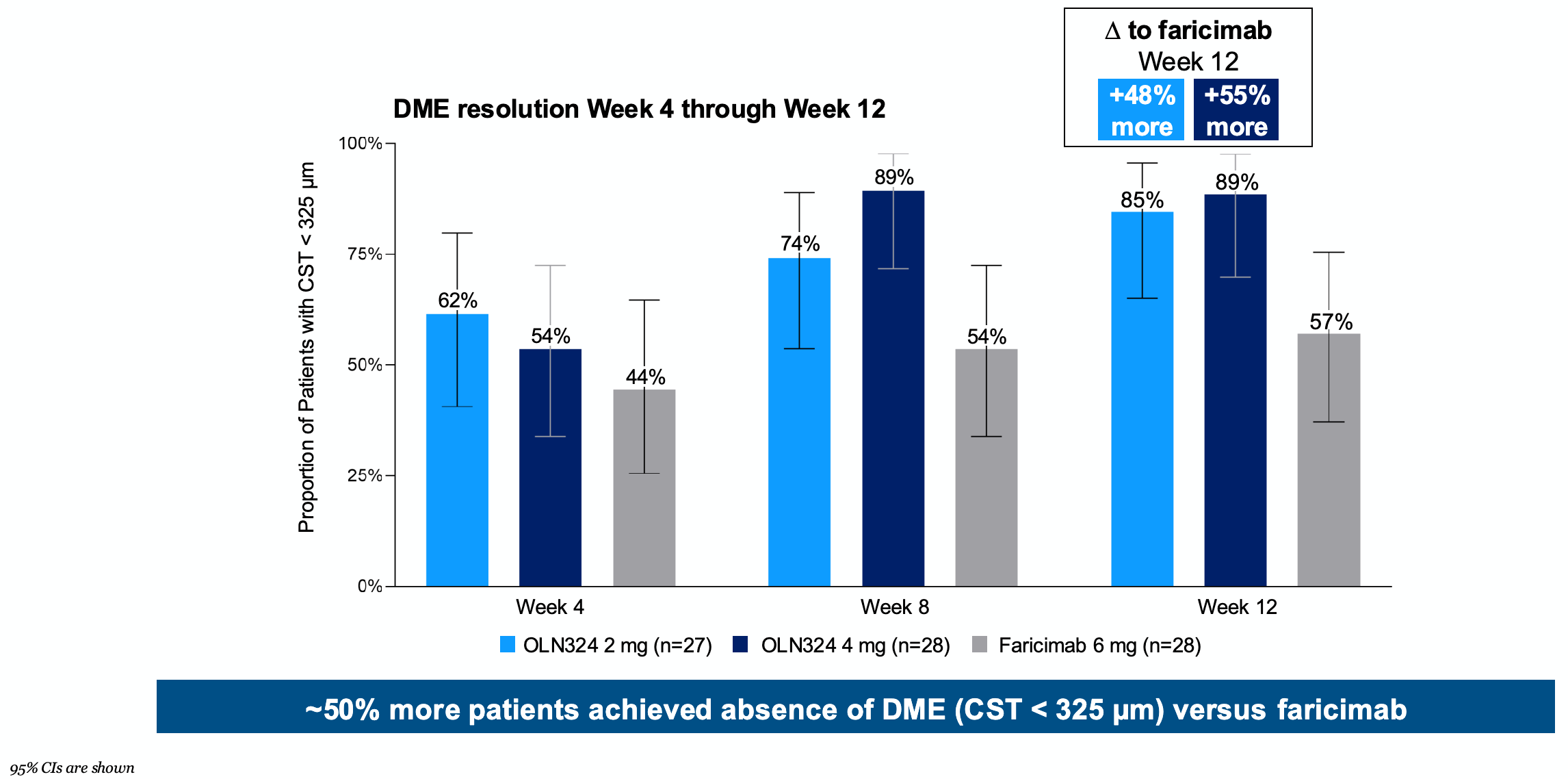
While EyeBio’s pivotal programs measured themselves against older first-generation monotherapies like ranibizumab (Lucentis) in BRUNELLO and aflibercept 2 mg (Eylea) in MALBEC/TORRONTES, Ollin tested OLN324 directly head-to-head against Vabysmo (faricimab) right out of the gate in its 164-patient US Phase 1b JADE trial reported in January and March 2026. In DME, OLN324 4 mg achieved ~75% greater CST reduction at Week 1 (-79 µm vs. -45 µm) and ~50% greater reduction at Week 12 (-180 µm vs. -121 µm), with nearly 90% of patients achieving absence of DME (<325 µm) at Week 12 compared to 57% on faricimab.
In wAMD, while overall CST drying was roughly equivalent to faricimab, OLN324 delivered a +2.2-letter best corrected visual acuity (BCVA) advantage over faricimab and achieved about 50% greater, faster, and more durable flattening of pigment epithelial detachments (PEDs), a notoriously difficult anatomical feature linked to late scarring and vision loss. Across a 12-week treatment-free observation window through Week 20, OLN324 required fewer retreatments than faricimab and posted zero cases of intraocular inflammation compared with 1 case on faricimab.
On the back of this data, Ollin closed an oversubscribed $330 million Series B round on June 24, 2026, bringing total equity raised to $430 million. The round was co-led by new investor TCGX and founding investor ARCH Venture Partners, joined by a16z Bio+Health, Blackstone Multi-Asset Investing, Commodore Capital, Canada Pension Plan Investment Board (CPP Investments), RA Capital Management, T. Rowe Price-advised accounts, Mubadala Capital, and Monograph Capital. The Series B proceeds were dedicated to launching multiple global Phase 3 trials for OLN324 in DME (ATACAMA trial) and wAMD in the fourth quarter of 2026, alongside advancing OLN102 (TSHR x IGF-1R mAb licensed from China-based VelaVigo) into the clinic.
That is, until Johnson & Johnson agreed to acquire the company on November 16, 2026 for $2.2 billion upfront in cash, plus up to approximately $1.125 billion in additional regulatory and commercial milestone payments, totaling over $3.3 billion. In parallel with the acquisition, Johnson & Johnson entered into a separate development funding agreement with Blackstone Life Sciences, under which Blackstone committed $750 million over multiple years (contingent upon closing) to help fund the Phase 3 clinical advancement of OLN324 in exchange for future milestone payments and single-digit royalties. The deal is expected to close before the end of 2026 pending regulatory approvals and serves as a major reentry for Johnson & Johnson into the retinal therapeutics market, following its earlier setback with MeiraGTx’s retinal gene therapy program.
Conclusion
The J&J-Ollin acquisition is yet another instance of the China “Me-Better” Arbitrage model: fast discovery and early human proof-of-concept out of China, paired with Western clinical execution and a clean geopolitical wrapper that Big Pharma can buy outright. Where EyeBio used a similar asset-centric launchpad to bet on novel biology and found itself navigating the trade-offs of Wnt agonism in BRUNELLO, Ollin took the more de-risked & direct route of optimizing Vabysmo and testing it head-to-head. Whether OLN324 ultimately dethrones Vabysmo and challenges the Eylea franchise, or whether preclinical OLN102 (TSHR x IGF-1R dual targeting antibody) eventually carves out a niche Thyroid Eye Disease (TED) behind Tepezza, is an open question. One thing is already clear: the China “Me-Better” Arbitrage is continues to generate spectacular short-term returns, on the order of multi-billion exits is less than 3 years.
Ophthalmology Competitive Landscape
All charts reflect data current as of the specified date and may not include every drug development program, although we aimed to capture the vast majority. Please feel free to email me at biotechreadout@gmail.com with “CHARTS” in the subject line to share suggestions or request chart updates.
Press ⬇️ to navigate to a section