

Disclaimer: This newsletter is for educational and informational purposes only and does not constitute medical, investment, or financial advice, nor does it establish a provider-patient relationship. Content may include forward-looking statements and discussions of investigational therapeutic candidates that are not FDA/EMA approved; their safety and efficacy remain unestablished and clinical outcomes are unpredictable. While we strive for accuracy, all information is provided as is without guarantees. As of the date of publication, the author holds no direct equity positions in the specific companies mentioned in this issue nor receives third-party compensation for this coverage. Please find a complete version of our disclaimers at the bottom of the article and linked here.

Press ⬇️ to go down to a section and ⬆️ to go back up to the Table of Contents
Table of Contents
This week, we discuss:
China Biotech
Conferences
ESMO 2026 ⬇️
Approvals
Inovio - Voceryq (DNA plasmid HPV6, HPV11, IL12) / Approved (RRP) ⬇️
Clinical Trial Data
Eli Lilly - Retatrutide (GGG) / Phase 3 (T2D) ⬇️
Genmab - Petosemtamab (EGFR x LGR5 mAb) / Phase 3 (HNSCC) ⬇️
Regeneron - ALN-CIDEB (CIDEB RNAi) / Phase 1/2 (MASLD) ⬇️
Merck - Efinopegdutide (GLP1/glucagon dual agonist) / Phase 2b success (F2-3 MASH) ⬇️
Novartis - Remibrutinib (BTK inhibitor) / Phase 3 (RMS) ⬇️
Oruka - ORKA-001 (IL-23p19 mAb HLE) / Phase 2 (plaque psoriasis) ⬇️
China Biotech
Wondering why we discuss China Biotech every week? Tap here to learn more.
Financing Activity for China versus Rest of World
for the week ending November 6, 2026
China Biotech outstripped rest-of-world financing by almost 4-fold. China financing activity solely consisted of upfront payment for licensing agreements with AbbVie, Boehringer Ingelheim, ASKA Pharma, Caldera, and Evommune.
Biotech Industry Digests Restrictions on Foreign Investment
Two weeks ago, we discussed the U.S. Department of the Treasury’s draft regulations under the Comprehensive Outbound Investment National Security (COINS) Act, which propose strict limitations on U.S. investments in Chinese biotech and pharmaceutical assets. Since then, industry lobbyists have rallied to clarify the scope & scale of the proposal and push back within the 45-day public comment period (comments due by December 7, 2026).
The proposed rules bar U.S. companies and investors from taking equity stakes in Chinese biotech companies. They also include a broad and ambiguous provision prohibiting “joint ventures” between U.S. and Chinese partners to finance, develop, or commercialize drugs, which threatens a wide range of modern medical collaborations. Endpoints observed that one-off product licensing deals (like Gilead Sciences paying $1.28 billion for a PepStar Therapeutics drug without ongoing collaboration) are expected to be permitted because licensing was omitted from the prohibitions, more complex, multi-asset deals involving co-development, co-commercialization, and knowledge-sharing (such as Pfizer’s partnership with Innovent Biologics) risk being classified as prohibited joint ventures. Legal and industry experts note that transactions involving profit/loss sharing or “synthetic joint ventures” will require careful, case-by-case evaluation. I recommend you read the full Endpoints article if you’re interested in this subject.
Sources: Endpoints article
FDA Clears a Path for Customized Gene Therapy
On October 27, 2026, the FDA released a draft guidance outlining a regulatory pathway for approving individualized gene editing therapies designed to fix single-patient mutations, building on the success of last year’s custom CRISPR treatment for an infant nicknamed “Baby KJ” (Kyle Patrick Muldoon, Jr.). Against this backdrop of decoupling and financial friction with China, the FDA’s new framework for individualized CRISPR treatments serves a dual strategic purpose: removing regulatory bottlenecks and incentivizing domestic R&D.
Baby KJ’s story involved a patient-specific LNP-encapsulated base editor developed under emergency conditions at UPenn in the 6-month span after his birth as a treatment for an ultra-rare genetic condition, neonatal-onset carbamoyl-phosphate synthetase 1 (CPS1) deficiency (affects 1 in 1,300,000 persons; 50% mortality in early infancy). Results from this remarkable case study were published in NEJM in May 2025. It showed that Baby KJ “was able to receive an increased amount of dietary protein and a reduced dose (to half the starting dose) of a nitrogen-scavenger medication, despite the “stress tests” presented by consecutive viral infections.” In Baby KJ’s case, a single-patient, expanded-access IND application was submitted to the FDA when the patient was 6 months of age, which was approved 1 week later. The IND was supported by:
A preclinical safety study in cynomolgus monkeys (result: nominated 0.1 mg per kilogram as a potentially safe initial clinical dose for the patient)
An in vitro assessment of off-target effects in lentivirus-transduced HuH-7 cells & primary human hepatocytes (result: low level of off-target editing at an intronic site in the ATP7B gene not considered to represent biologic risk)
Preclinical proof-of-concept study in Rosa26-Q335X transgenic mice that matched the patient’s genotype (result: 42% whole-liver corrective editing)
A few months later, Fyodor Urnov, director of therapeutic R&D at the Innovative Genomics Institute (IGI), revealed at a UK rare disease symposium that manufacturing the personalized CRISPR gene-editing treatment for Baby KJ cost $1.65 million, reflecting the physical manufacturing costs alone and does not include donated time, labor, or the significant financial loss taken by manufacturing partner Danaher. Furthermore, Urnov at IGI and Danaher announced that they are developing a blueprint to deliver personalized CRISPR treatments faster and at scale. The approach uses platform-based testing, functional cell assays, and targeted off-target safety testing while maintaining regulatory rigor, with full regulatory documents expected in 1Q 2027. Urnov and 2020 Nobel laureate Jennifer Doudna (co-discovered CRISPR) co-founded Aurora Therapeutics in early 2026 to focus on bespoke gene therapies. Until now, the biggest bottleneck for the Aurora team and others looking to develop customized gene therapies for ultra-rare diseases is a scalable regulatory path.
The FDA’s new framework allows multiple custom therapies targeting different mutations within the same gene and disease to fall under a single biologics license application (BLA). This approach streamlines preclinical testing and avoids “rerunning the gauntlet” for subsequent variants. The guidance defines what must remain constant (such as the delivery vehicle and formulation) and what can change (such as the guide RNA molecule). BLAs are restricted to a single gene for a single disease, rather than grouping multiple rare diseases with shared pathology. Additionally, technologies with fundamentally different mechanisms (like base editing vs. prime editing) cannot share the same application. The FDA is accepting feedback on the draft guidance for 30 days. Meanwhile, the Department of Health and Human Services (HHS) announced that the Centers for Medicare & Medicaid Services (CMS) plans to accept proposals for new payment negotiation models for cell and gene therapies.
Sources: HHS press release, NEJM paper, Endpoints article
Conferences
ESMO 2026
The European Society for Medical Oncology (ESMO) 2026 Congress took place from October 23 to October 27, 2026, in Madrid, Spain. Europe’s largest cancer conference produced a deluge of clinical breakthroughs, so we split our ESMO 2026 coverage into four separate articles:
Approvals
Inovio - Voceryq (DNA plasmid HPV6, HPV11, IL12) / Approved (RRP)
On October 30, 2026, the FDA granted accelerated approval to Voceryq (doruxapapogene ralaplasmid and lalikinogene sifuplasmid-gxfd / INO-3107), developed by INOVIO Pharmaceuticals, making history as the first plasmid DNA-based medicine approved in the United States. Voceryq is indicated to reduce the frequency of surgical papilloma excisions in adults suffering from recurrent respiratory papillomatosis (RRP), a rare, debilitating disease driven primarily by human papillomavirus (HPV) types 6 and 11. Since the drug was granted an accelerated approval based on an intermediate clinical endpoint reasonably likely to predict clinical benefit (reduction in surgery frequency), continued approval is contingent upon the verification of clinical benefit in forthcoming confirmatory studies. Per FDA requirements, INOVIO is tasked with submitting a draft protocol for the confirmatory trial, with final protocol alignment expected in mid-2027.
Recurrent respiratory papillomatosis (RRP) is characterized by the chronic growth of benign, wart-like papillomas in the respiratory tract, most commonly on and around the vocal cords. While technically benign, these tumors can cause severe, life-threatening airway obstructions and severely impair speech and quality of life. Prior to Voceryq‘s approval, the standard of care relied exclusively on frequent surgical debulking to clear the airways. However, because the underlying viral infection remains active, the growths aggressively return, often forcing patients to undergo repeat surgeries as frequently as every few weeks, which carries a cumulative risk of permanent laryngeal damage. Voceryq was designed to address the root cause of the disease by deploying a targeted DNA immunotherapy. The treatment utilizes two DNA plasmids: one encoding for HPV-6 and HPV-11 viral antigens, and the other encoding interleukin-12 (IL-12), an immune-enhancing cytokine designed to stimulate a robust cell-mediated immune response against HPV-infected cells. The therapy is administered via intramuscular injection using INOVIO’s proprietary CELLECTRA 5PSP delivery device, which applies brief electrical pulses to help safely move the DNA medicine directly into the patient’s cells. The therapeutic course begins after a standard-of-care surgical debulking of visible papillomas and follows a 9-week dosing schedule without requiring additional surgical interventions as part of the regimen.
The FDA’s accelerated approval decision was primarily supported by data from RRP-001 (NCT04398433), an open-label, multicenter Phase 1/2 clinical trial that enrolled 32 adult patients with RRP linked to HPV-6, HPV-11, or both. Eligible participants had a history of heavy disease burdens, having undergone at least two surgical interventions in the 12 months prior to enrollment, alongside a scheduled surgery at entry. Among a subset of 26 patients who had undergone at least three baseline surgeries (with a median of 4.5 surgeries), 27% achieved a complete response, defined as a complete absence of surgical papilloma excisions throughout 12 months of post-treatment follow-up. Regulators noted that this sustained disease-free outcome is not expected under the natural history of untreated or standard-management RRP. All 32 participants completed the trial, with the vast majority of treatment-related adverse events being mild to moderate (Grade 1 or 2) and transient. The most common adverse reactions (occurring at an incidence greater than 5%) included injection site reactions, headache, fatigue, hypertension, nausea, and dizziness. There were no Grade 4 or Grade 5 common adverse events reported.
Sources: Inovio press release, Inovio slide deck, new Voceryq label
Clinical Trial Data
Eli Lilly - Retatrutide (GGG) / Phase 3 (T2D)
On October 28, 2026, Eli Lilly announced positive topline results from the Phase 3 TRANSCEND-T2D-2 clinical trial, showcasing the efficacy of its investigational “triple-G” receptor agonist, retatrutide, in a landmark head-to-head matchup against Novo Nordisk’s flagship GLP-1 receptor agonist, Ozempic (semaglutide 2 mg), for adults with type 2 diabetes.
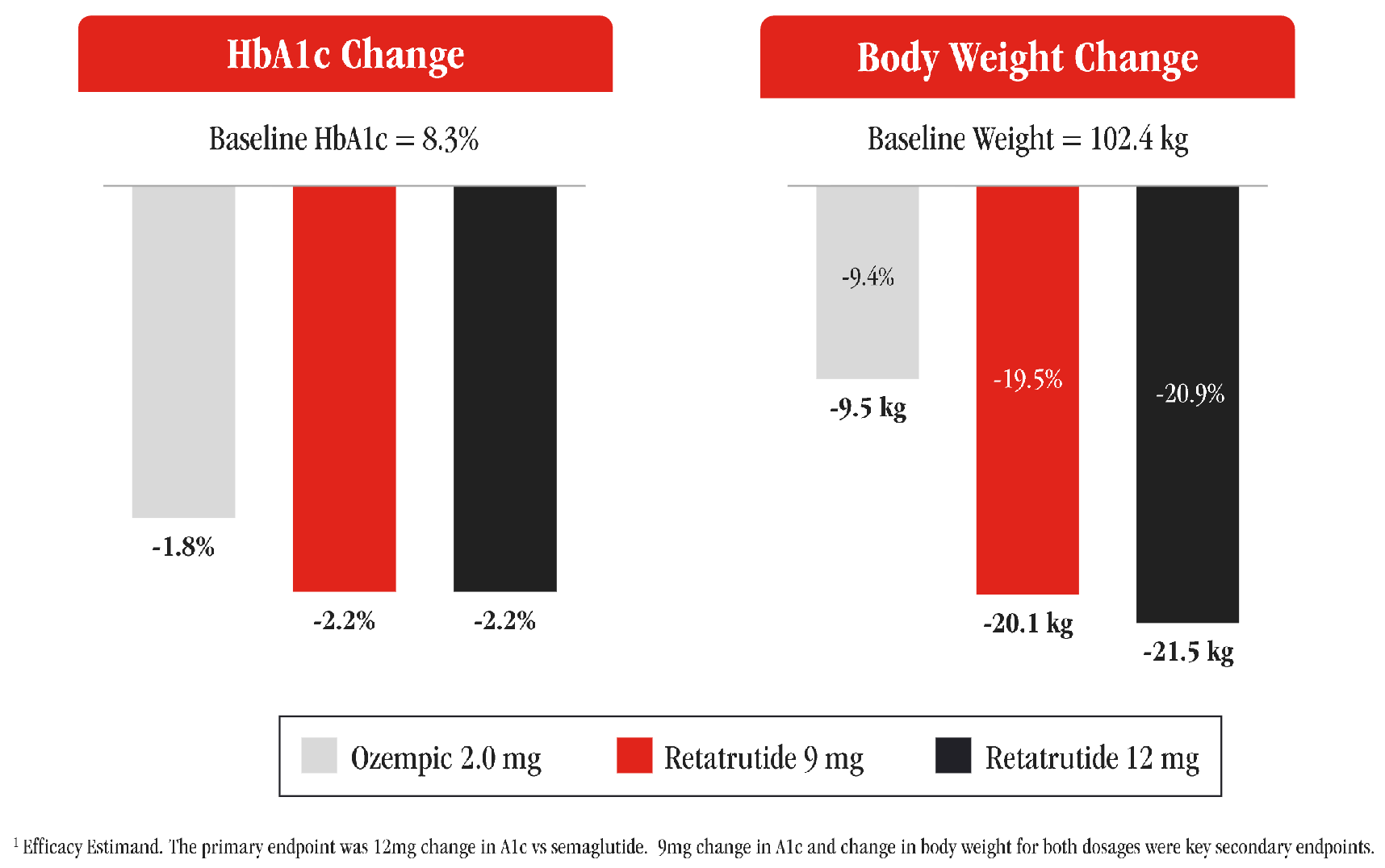
Retatrutide is a first-in-class, once-weekly single-molecule peptide engineered to simultaneously activate three distinct hormone receptors: glucose-dependent insulinotropic polypeptide (GIP), glucagon-like peptide-1 (GLP-1), and glucagon receptors. This multi-agonist mechanism is designed to blend potent blood sugar regulation and appetite suppression with glucagon-mediated increases in energy expenditure, offering a more comprehensive metabolic profile than single- or dual-incretin therapies. That thesis was put to the test in the Phase 3 TRANSCEND-T2D-2 clinical trial, which enrolled 1,298 adult participants with type 2 diabetes inadequately controlled on metformin (with or without an SGLT2 inhibitor). At 80 weeks, retatrutide met its primary noninferiority endpoint and successfully outperformed Ozempic across key glycemic and anthropometric parameters. Starting from a mean baseline HbA1c of 8.3%, both the 9 mg and 12 mg doses of retatrutide lowered HbA1c by an average of 2.2%, compared to 1.8% for Ozempic 2 mg. Retatrutide more than doubled the weight loss seen with the active comparator. Participants taking retatrutide achieved mean body weight reductions of 19.5% (about 20.1 kg or 44.3 lbs) at the 9 mg dose and 20.9% (approx. 21.5 kg or 47.4 lbs) at the 12 mg dose, compared to 9.4% (approx. 9.5 kg or 20.9 lbs) with Ozempic 2 mg (p < 0.001 for both retatrutide doses). Retatrutide also delivered superior improvements in key cardiometabolic parameters, including systolic blood pressure, non-HDL cholesterol, and triglycerides. The overall adverse event profile mirrored known incretin-class side effects, primarily driven by gastrointestinal events (such as diarrhea, nausea, vomiting, and constipation) that were mostly mild-to-moderate and transient. However, treatment discontinuations due to adverse events were higher in the retatrutide arms (4.8% for 9 mg and 7.9% for 12 mg) compared to 2.7% for Ozempic.
Following these positive topline results, approximately 650 participants will enter a 24-week extension period to evaluate longer-term safety and efficacy. Eli Lilly intends to compile the comprehensive dataset for presentation at an upcoming medical congress and peer-reviewed publication, paving the way for anticipated regulatory submissions.
Sources: Eli Lilly press release, Eli Lilly slide deck
Genmab - Petosemtamab (EGFR x LGR5 mAb) / Phase 3 (HNSCC)
On October 28, 2026, Genmab announced positive topline results from the global Phase 3 LiGeR-HN1 trial, evaluating petosemtamab (an EGFR x LGR5 bispecific antibody) in combination with Keytruda (pembrolizumab) for the first-line treatment of patients with PD-L1 positive recurrent or metastatic head and neck squamous cell carcinoma (HNSCC). Evaluated at a first planned interim analysis by an independent data monitoring committee, the trial successfully met its dual primary endpoints, signaling a potentially practice-changing breakthrough in a malignancy that historically carries a poor prognosis.
At the first interim analysis, the Phase 3 LiGeR-HN1 trial demonstrated a statistically significant and clinically meaningful benefit across both primary endpoints, which held true regardless of human papillomavirus (HPV) status. The petosemtamab combination reduced the risk of death by 50% compared to pembrolizumab alone, showing a Hazard Ratio (HR) of 0.50 (p < 0.0001). Patients receiving the combination experienced an odds ratio of 3.17 (p < 0.0001), indicating that they were more than three times as likely to achieve an objective tumor response. The safety profile of the combination was generally well tolerated and aligned with the known, individual safety profiles of both agents, with no new safety signals observed. Following these positive topline results, Genmab plans to actively engage with global regulatory authorities (including the FDA, which has already granted petosemtamab Breakthrough Therapy Designation in this setting) to discuss regulatory pathways. Additionally, the company intends to submit the comprehensive dataset for presentation at an upcoming major medical meeting.
Sources: Genmab press release
Regeneron - ALN-CIDEB (CIDEB RNAi) / Phase 1/2 (MASLD)
On October 30, 2026, Regeneron announced promising Phase 1/2 clinical data for ALN-CIDEB, an investigational RNA interference (RNAi) therapeutic developed in collaboration with Alnylam Pharmaceuticals. Targeting metabolic dysfunction-associated steatotic liver disease (MASLD), the early-stage trial evaluated the asset’s capability to safely knockdown hepatic lipid storage and rapidly reduce liver fat accumulation. ALN-CIDEB is designed to silence the expression of the CIDEB (Cell death-inducing DFFA-like effector B) gene, which encodes a key structural protein that regulates lipid droplet formation and storage in hepatocytes. Human genetics partially validate this target: naturally occurring loss-of-function variants in CIDEB are known to protect against hepatic lipid accumulation and significantly lower the long-term risk of developing severe fatty liver disease and steatohepatitis. This results was reproduced in transgenic CIDEB-knockout mice. By utilizing RNAi technology to selectively degrade CIDEB messenger RNA in the liver, the therapeutic is designed to prevent the cellular packaging and buildup of excess fat.
At the 12-week interim evaluation of the Phase 1/2 study, ALN-CIDEB demonstrated a striking pharmacodynamic effect on hepatic metabolism. Patients treated with ALN-CIDEB achieved a dramatic mean reduction in liver fat of up to 70% from baseline at the evaluated active dose levels. The therapy exhibited an encouraging early safety profile, with treatment-related adverse events generally mild to moderate and transient, indicating clean initial tolerability for the RNAi platform in this metabolic patient population. Regeneron and Alnylam are advancing the clinical program toward broader development. Plans are underway to expand patient cohorts to evaluate longer-term histologic endpoints, including potential impacts on inflammation and fibrosis, and to design larger registrational trials intended to confirm ALN-CIDEB’s therapeutic profile in broader MASLD and MASH populations.
Sources: Regeneron press release
Merck - Efinopegdutide (GLP1/glucagon dual agonist) / Phase 2b success (F2-3 MASH)
On November 5, 2026, Merck announced positive Phase 2b topline results for efinopegdutide, a once-weekly dual receptor agonist targeting both glucagon-like peptide-1 (GLP-1) and glucagon receptors, which was originally licensed from Hanmi Pharmaceutical. Presented at the American Association for the Study of Liver Diseases (AASLD) The Liver Meeting, the trial evaluated the therapy in adults with biopsy-confirmed metabolic dysfunction-associated steatohepatitis (MASH) and moderate-to-advanced liver fibrosis (F2–F3 stages).
At 52 weeks of the Phase 2b trial, efinopegdutide demonstrated strong histological efficacy across multiple dosing arms. Every dose of efinopegdutide significantly outperformed placebo (13%) in MASH resolution without worsening fibrosis, with resolution rates hitting 56% in the 4 mg arm, 63% in the 7 mg arm, and 61% in the 10 mg arm (compared to 53% in the open-label semaglutide arm). On the key secondary endpoint of improving liver fibrosis by ≥1 stage without worsening MASH, the 7 mg dose showed the most robust profile, achieving a 52% improvement rate compared to 21% for placebo and 25% for semaglutide. Notably, the highest dose (10 mg) saw a blunting of this specific fibrosis benefit, partially driven by protocol-defined handling of dropouts. Treatment discontinuations due to adverse events were 3% to 4% for the lower/mid doses, rising to 11% in the 10 mg arm. Merck is expected to use these findings to finalize phase 3 clinical development plans, refine regulatory alignment, and advance efinopegdutide into registrational trials for patients with advanced MASH and fibrosis.
Sources: Endpoints article
Novartis - Remibrutinib (BTK inhibitor) / Phase 3 (RMS)
On October 23, 2026, Novartis presented late-breaking Phase 3 data from the REMODEL-1 and REMODEL-2 clinical trials at the 10th Joint ACTRIMS-ECTRIMS Meeting (MSToronto2026), simultaneously published in Lancet. The trials evaluated Rhapsido (remibrutinib), a covalent Bruton’s tyrosine kinase (BTK) inhibitor, for the treatment of adult patients with relapsing multiple sclerosis (RMS). Note that remibrutinib is marketed as Rhapsido and is approved for chronic spontaneous urticaria (CSU) and symptomatic dermographism, but is still investigational for RMS.
The twin Phase 3 REMODEL-1 and REMODEL-2 trials were randomized, double-blind, active-controlled global studies that evaluated the efficacy and safety of oral remibrutinib (100 mg twice daily) against the established oral immunomodulator Aubagio (teriflunomide; 14 mg once daily) in adult patients with RMS. Both trials successfully met their primary endpoint, demonstrating robust relapse reduction compared to the active comparator. Remibrutinib significantly lowered annualized relapse rates by 35.2% in REMODEL-1 and 31.2% in REMODEL-2 compared to teriflunomide, translating to an average frequency of roughly one clinical relapse every 13 years under sustained therapy. Remibrutinib sharply suppressed brain MRI lesion activity, reducing active lesions by up to 70%. Remibrutinib exhibited a favorable and clean safety profile, most notably showing zero cases meeting Hy’s Law criteria and no systemic liver safety signals. Treatment discontinuations due to adverse events were lower with remibrutinib (3.1%) than with teriflunomide (5.8%). Novartis announced plans to move swiftly toward global regulatory submissions seeking approval for remibrutinib in relapsing multiple sclerosis.
Sources: Novartis press release, Lancet paper
Oruka - ORKA-001 (IL-23p19 mAb HLE) / Phase 2 (plaque psoriasis)
On October 26, 2026, Oruka Therapeutics announced positive Week 16 results from its Phase 2b EVERLAST-B trial evaluating ORKA-001, a next-generation, half-life extended monoclonal antibody targeting IL-23p19, in adults with moderate-to-severe plaque psoriasis. The data closely mirror the efficacy and safety profiles seen in the earlier EVERLAST-A trial, reinforcing the asset’s potential to deliver long-lasting skin clearance with infrequent maintenance dosing. ORKA-001 is an ultra-potent, engineered monoclonal antibody designed to selectively inhibit IL-23p19. By blocking the interleukin-23 pathway, which drives the survival and expansion of pathogenic T helper 17 (Th17) cells, ORKA-001 shuts down the core inflammatory cascade responsible for plaque psoriasis. Psoriasis management often suffers from patient compliance hurdles due to frequent self-injection schedules required by existing biologic therapies. Crucially, the molecule incorporates half-life extension (HLE) technology, allowing therapeutic drug concentrations to remain well above effective trough levels for extended periods, paving the way for infrequent dosing regimens (such as once or twice-yearly maintenance).
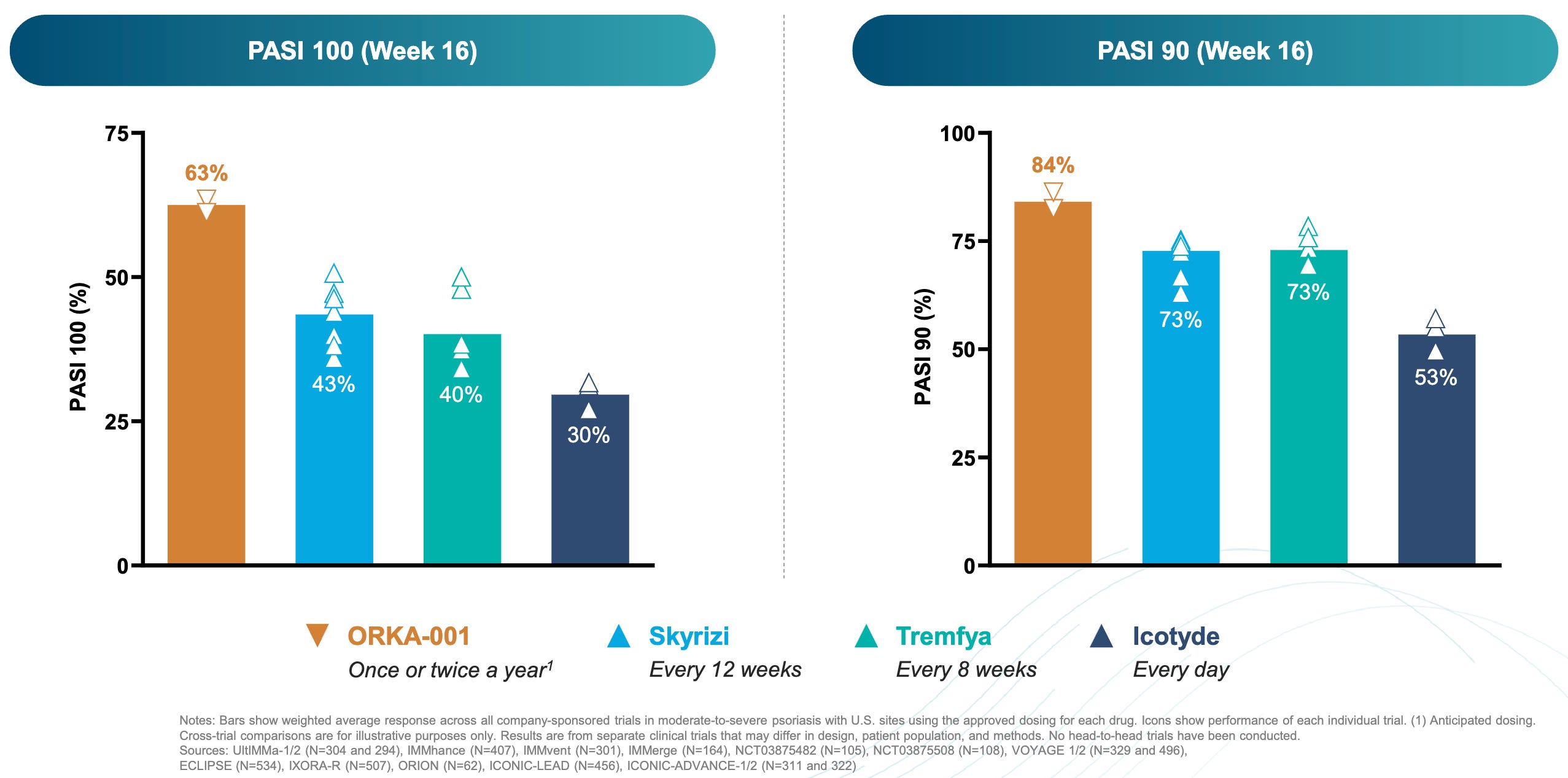
At Week 16, the high-dose (600 mg) group of ORKA-001 demonstrated evidence of efficacy. About 61% of patients achieved complete skin clearance (PASI 100), replicating the high-level performance established in previous readouts. Additionally, 86% of patients achieved a PASI 90 response and an IGA score of 0 or 1, indicating almost entirely clear skin. Treatment-emergent adverse events were mostly mild, with no dose-dependent toxicity trends and zero injection-site reactions reported. Oruka is advancing ORKA-001 toward Phase 3 clinical trials targeted to launch in the first half of 2027 using the high-dose regimen. Additionally, the company anticipates reporting longer-term 52-week data from the EVERLAST-A trial in December 2026.
Sources: Oruka press release, Oruka slide deck
Love biotech? Check out Biotech Readout’s full content library, or navigate directly to a segment that interests you:
Frontiers in Medicine: Exploring the frontiers of our understanding and treatments for disease.
Medical History: Recovering forgotten relics in the history of medicine.
Acquisitions: Exploring the innovation behind acquired companies.
Weekly Readout: A digest of new clinical data from the past week.
To contact us, please send us an email at biotechreadout@gmail.com
Disclaimers
Investigational Status Disclaimer
The therapeutic candidates discussed in this newsletter are currently in clinical development and have not been approved for commercial sale by the U.S. Food and Drug Administration (FDA), the European Medicines Agency (EMA), or other global regulatory authorities. Their safety and efficacy have not been established. References to pipeline products and ongoing clinical trials involve significant risks and uncertainties. Statements regarding the potential safety, potency, or efficacy of investigational drugs reflect current hypotheses and are not a guarantee of future performance or regulatory clearance. The outcome of clinical trials is inherently unpredictable, and clinical results from earlier stages may not be predictive of results in later, larger-scale trials.
No Medical Advice Disclaimer
This newsletter is for informational and educational purposes only. The content is not intended to be a substitute for professional medical advice, diagnosis, or treatment. Always seek the advice of your physician or another qualified health provider with any questions you may have regarding a medical condition. Never disregard professional medical advice or delay in seeking it because of something you have read in this publication.
No Patient-Provider Relationship Disclaimer
The information provided in this newsletter is for educational and analytical purposes only. Receipt of this information, or any interaction with this content, does not create a physician-patient, pharmacist-patient, or any other professional-provider relationship between you and the authors or publishers. This newsletter should not be used as a substitute for a personal consultation with a qualified healthcare professional.
Forward-Looking Statements Disclaimer
This newsletter contains “forward-looking statements” regarding future events, including clinical trial timing, regulatory milestones, and projected market performance. These statements are based on current expectations and assumptions that are subject to significant risks and uncertainties. Actual results may differ materially from those expressed or implied. We undertake no obligation to update these statements as a result of new information or future developments.
Third-Party Links & Content Disclaimer
This newsletter contains links to third-party websites, including clinical trial registries and corporate presentations. Biotech Readout does not endorse, guarantee, or assume responsibility for the accuracy or reliability of any information offered by third-party providers.
Errors and Omissions Disclaimer
While we strive for technical accuracy, the information in this newsletter is provided on an “as is” basis with no guarantees of completeness, accuracy, or timeliness. Biotech Readout assumes no liability for any errors or omissions in the content of this publication.
Non-Endorsement Disclaimer
Any reference to specific commercial products, processes, or services by trade name, trademark, or manufacturer does not constitute or imply an endorsement or recommendation by the author. All trademarks are the property of their respective owners.
No Investment Advice Disclaimer
This newsletter is for informational purposes only and does not constitute financial, investment, or legal advice. The author is not a registered investment advisor. You should consult with a professional financial advisor before making any investment decisions. The biotechnology sector is highly volatile; past performance is not indicative of future results.
Conflict of Interest Disclaimer
The author of this newsletter maintains a position of independence. At the time of publication, the author holds no direct financial interest, equity, or options in any of the companies mentioned in this report. No compensation has been received from any third party to feature or analyze specific therapeutic candidates or corporate entities.